The Hibberts were a City of London merchant house with Jamaican plantation interests, running from a slave trader born in 1710 to a banker who died in 1881. Their compensation claims are recorded in University College London's Legacies of British Slave-ownership database, and their business is discussed at length in two published scholarly works. None of those sources, however, does the thing a genealogist actually needs doing: telling you which Thomas is which.
Across fifteen profiled individuals this family fields four men named Thomas, three named George, and two each named Robert, William and John. They overlap in life, share a surname, occupy the same trade, and in one case marry women of the same surname. Getting one of them wrong does not produce a visible error — it produces a clean, confident, wrong answer that will pass unexamined into a family tree and stay there.
What follows is not a finished pedigree. It is a record of how three specific name collisions in this family were separated, what evidence did the separating, and — in the case that matters most — where the evidence ran out and the connection was left open rather than assumed.
The two Roberts, and the two Nembhards
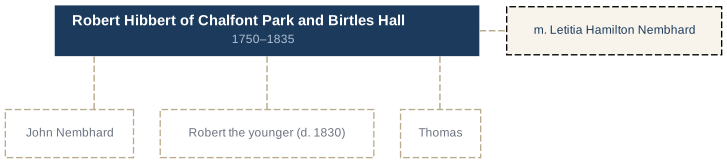
Robert Hibbert of Chalfont Park (1750–1835) and Robert Hibbert junior (1769–1849) are nineteen years apart, both merchants, both Hibberts. That alone is manageable. The trap is one layer deeper: the elder married Letitia Hamilton Nembhard, and the younger married Elizabeth Jane Nembhard. Two men of the same forename and surname, in the same trade, married to women who also share a surname.
The elder Robert's record names his children as John Nembhard, Robert the younger (d. 1830), and Thomas. A first-name match would take “Robert the younger” and bind it to the profiled Robert Hibbert junior — the only other Robert in the family. It is the obvious reading, and it is wrong.
The two Williams, and the one link that holds
Not every collision ends in a refusal. William Hibbert (1759–1844) lists eight children, and one of them is William Tetlow — not a bare forename, but a forename and a distinctive second name together. There is a profiled William Tetlow Hibbert (1792–1881), merchant and banker.
Here the evidence converges rather than conflicts. The full name matches, not just the first token. The dates are consistent — a son born in 1792 to a father born in 1759 is an ordinary paternal age. And there is a third strand: the elder William's wife was Elizabeth Greenhalgh, and William Tetlow Hibbert named one of his own sons Arthur Greenhalgh — a grandmother's maiden name carried forward, exactly as this class of family did.

The three Georges, and the man who is not one
George Hibbert (1757–1837) is the family's most prominent figure — West India merchant, Member of Parliament for the City of London, chairman of the West India Dock Company. He is followed by George Hibbert junior (1796–1882), a merchant, and then by a third George in the same dataset: George Hibbert Oates (1791–1837), whose occupation is recorded as overseer.
Oates is the useful case, because he resolves on reading rather than on evidence. His surname is not Hibbert — it is Oates. “George Hibbert” is his given name, and the Hibbert in the middle of it is a forename, not a family tie. He sits in the dataset as a connected person; whether that name records a godparent, an employer, or something else is not stated by the record, and is not guessed at here.

Every child below is drawn as a leaf, not a link.
That is the finding, not a limitation of the drawing.
Why the trees are small
A single sprawling tree of this family would look more impressive and would be, in several places, a fabrication. The source links parents to children by forename alone. In a family that reuses forenames this heavily, that is not enough to bind two records together, and a diagram that joins them anyway is asserting something nobody checked.
So each unit is drawn separately: one person, their stated spouse, and their children as named leaves. Where a child later appears in their own right, that is a claim requiring its own evidence — made once here, for William Tetlow Hibbert, on three converging strands. Everywhere else the connection is left visibly open.
This is the discipline the practice applies to paying work. A negative or an unproven link is stated as such and priced honestly, rather than closed with an assumption that reads perfectly well on the page and cannot be checked by the person relying on it.
The fifteen
Each links to its record in UCL's Legacies of British Slave-ownership database, which is public and can be checked independently.
- Thomas Hibbert senior (1710–1780), slave trader and plantation owner. Children named in the record: Jane Harry, Margaret Harry, Charlotte Harry. UCL record
- Thomas Hibbert of Chalfont (1744–1819), merchant and landowner. Married Sophia Boldero. UCL record
- Robert Hibbert of Chalfont Park and Birtles Hall (1750–1835). Married Letitia Hamilton Nembhard. Children named in the record: John Nembhard, Robert the younger (d. 1830), Thomas. UCL record
- George Hibbert (1757–1837), west india merchant and plantation owner. Married Elizabeth Margaret Fonnereau. Children named in the record: Caroline, Charlotte, Edward, Elizabeth Sophia, Fanny, George, George, Georgiana Christiana, Harriet, Isabella, Mary Anne, Nathaniel, Octavia. UCL record
- William Hibbert (1759–1844), merchant. Married Elizabeth Greenhalgh. Children named in the record: Charles Richard, Elizabeth, James Pilkington, Letitia, Margaret, Mary Anne, Sarah, William Tetlow. UCL record
- Sir George Philips (1766–1847), west india merchant. Married Sarah Ann Philips, his cousin and daughter of Nathaniel Philips of Hollinghurst, Lancashire. (16 Oct. 1788). Children named in the record: 1 son, 1 son illegitimate. UCL record
- Robert Hibbert junior (1769–1849), merchant and plantation owner. Married Elizabeth Jane Nembhard. UCL record
- Samuel Hibbert (1783–1867), merchant. Married Caroline Hibbert. UCL record
- Thomas Hibbert of Birtles Hall (1788–1879). Married Mary Caroline Henrietta Cholmondely. Children named in the record: Caroline Essex, Dorothea Letitia, Francis, Georgiana Charlotte, Hugh Robert, Letitia Octavia, Reginald John, Thomas Francis. UCL record
- George Hibbert Oates (1791–1837), overseer. UCL record
- William Tetlow Hibbert (1792–1881), merchant and banker. Married Caroline Mary Cure. Children named in the record: Arthur Greenhalgh, Edward George, Grancis Jordon, Louise Mary Ann, Robert Henry. UCL record
- Thomas Hibbert junior (1795–1845). UCL record
- John Nembhard Hibbert (1796–1886), soldier. Married Jane Anne Alexander. UCL record
- George Hibbert junior (1796–1882), merchant. UCL record
- John Hubert Washington Hibbert (1804–1875), soldier. Married Julia Tichborne. Children named in the record: Cecilia Elizabeth Tichbourne, Edgar, Emily, Hubert, Lydia Anne Tichbourne, Oswald, Paul Edgar Tichbourne. UCL record
Published sources
- Hall, Draper, McClelland, Donington and Lang, Legacies of British Slave-Ownership: Colonial Slavery and the Formation of Victorian Britain (Cambridge University Press, 2014). Hibbert family case study, pp. 203–243; George Hibbert at pp. 52–53, 204, 207–213, 228.
- N. Draper, The Price of Emancipation: Slave-Ownership, Compensation and British Society at the End of Slavery (Cambridge University Press, 2010). pp. 19, 30, 33, 44, 51, 94, 143, 198, 237, 250–251.
- University College London, Legacies of British Slavery database, ucl.ac.uk/lbs. The individual record for each person named above is linked to that entry.